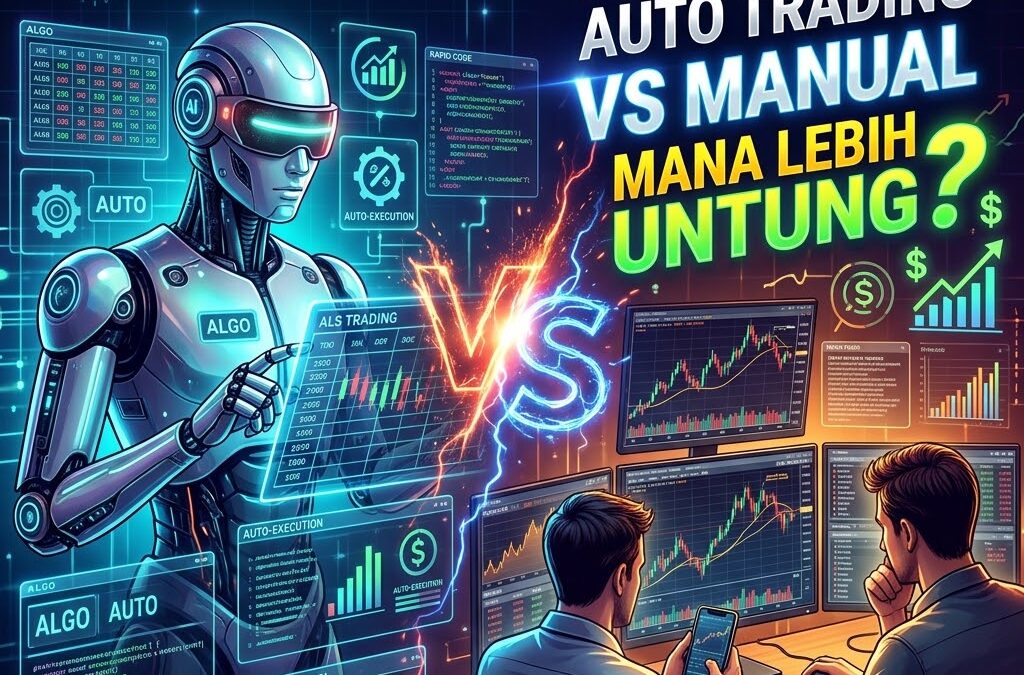
Bayangkan anda nak jual kuih-muih di pasar malam. Ada dua cara: satu, anda sendiri yang goreng, bungkus, dan jual satu persatu (manual); dua, anda pasang mesin yang goreng, bungkus, dan jual secara automatik (auto trading robot). Kedua-duanya boleh untung, tapi cara dan cabarannya berbeza. Artikel ini akan bandingkan robot auto trading dengan trading manual—mana yang lebih untung, lebih praktikal, dan sesuai untuk anda?
Bahagian Bahasa Melayu
1. Kos: Mesin vs Tenaga Sendiri
Kalau nak pasang mesin goreng kuih, anda kena beli mesin dulu—kos awal tinggi. Begitu juga dengan robot auto trading. Anda perlu bayar untuk:
- Perisian robot: Ada yang percuma, tapi yang bagus biasanya berbayar—RM500 hingga RM5,000 atau lebih. Contohnya, robot seperti MetaTrader Expert Advisors (EA) atau TradingView bots.
- Data dan broker: Robot perlukan data pasaran masa nyata. Broker seperti eToro, FBS, atau OctaFX ada yang sediakan API untuk robot, tapi ada yg kenakan yuran tambahan.
- Server: Robot perlu ‘hidup’ 24/7. Kalau PC rumah anda mati, robot berhenti. Jadi, ramai trader guna Virtual Private Server (VPS)—RM30 hingga RM150 sebulan.
Trading manual pula, kos awal lebih rendah. Anda cuma perlu:
- Modal awal (contoh: RM1,000 untuk akaun trading).
- Peranti (laptop atau telefon).
- Langganan data (kalau broker tak sediakan percuma).
Siapa menang? Manual lebih murah untuk mula. Tapi kalau anda serius nak scale, robot mungkin lebih jimat dalam jangka panjang—tak perlu bayar gaji ‘pekerja’ (anda sendiri)!
2. Konsistensi: Mesin Tak Kenal Lelah
Bayangkan anda jual kuih 10 jam sehari. Lama-lama, anda letih, fokus hilang, mungkin goreng kuih hangus. Robot auto trading tak kenal erti letih. Dia akan:
- Pantau pasaran 24 jam, 7 hari seminggu—tak kira tengah malam atau cuti umum.
- Eksekusi trade ikut strategi yang ditetapkan, tanpa terlewat atau teragak-agak.
- Elak kesilapan manusia—takde ‘tertekan butang salah’ atau ‘terlupa set stop-loss’.
Trading manual pula bergantung pada:
- Masa anda: Kalau anda ada kerja lain, susah nak monitor pasaran sentiasa.
- Kondisi fizikal dan mental: Letih? Stress? Sakit? Semua ini boleh ganggu keputusan trading.
- Disiplin: Ramai trader manual gagal sebab tak ikut trading plan—tergoda untuk ‘overtrade’ atau ‘revenge trade’.
Siapa menang? Robot lebih konsisten dalam eksekusi. Tapi ingat: robot cuma sebaik strategi yang diprogramkan. Kalau strategi buruk, robot pun akan rugi secara konsisten!
3. Emosi: Robot Takde Hati
Kita manusia ada perasaan. Kadang-kadang, perasaan ni boleh jadi musuh terbesar dalam trading. Contoh:
- Takut: ‘Aduh, dah turun ni, nanti rugi lagi!’—terus jual, padahal harga mungkin akan naik balik.
- Tamak: ‘Wah, dah untung RM100, nanti untung lagi!’—tak jual, tiba-tiba harga jatuh balik.
- Marah: ‘Rugi RM200 tadi, kena balas!’—terus buka trade baru tanpa analisis, rugi lagi.
Robot takde perasaan. Dia ikut peraturan yang ditetapkan—tak takut, tak tamak, tak marah. Kalau strategi cakap ‘jual’, dia jual. Takde ‘tapi…’ atau ‘nanti dulu…’.
Tapi, robot juga ada kelemahan emosi—emosi pemiliknya! Contoh:
- Anda ubah-ubah setting robot sebab tak sabar nak untung cepat.
- Anda matikan robot sebab takut rugi, padahal strategi masih valid.
- Anda tak ikut backtest dan terus guna robot tanpa uji cuba.
Siapa menang? Robot menang dalam mengelak emosi semasa trading. Tapi anda kena kawal emosi terhadap robot!
4. Kawalan: Anda Bos atau Robot Bos?
Dalam trading manual, anda yang buat keputusan. Anda:
- Boleh ubah strategi bila-bila masa ikut keadaan pasaran.
- Boleh ‘feel’ pasaran—contohnya, rasa ada ‘sentimen’ tertentu yang robot tak boleh detect.
- Boleh berhenti trading bila rasa tak sesuai (contoh: semasa berita besar seperti krisis ekonomi).
Robot pula, kawalan terhad pada apa yang diprogramkan. Contoh masalah:
- Tak fleksibel: Kalau pasaran tiba-tiba volatile (contoh: semasa pilihan raya atau krisis), robot mungkin terus trade ikut strategi lama dan rugi.
- Perlu pemantauan: Robot tak boleh fikir sendiri. Anda perlu pantau prestasinya dan ubah setting bila perlu.
- Risiko teknikal: Robot boleh ‘hang’, kena hack, atau ada bug yang rugikan anda.
Siapa menang? Manual lebih fleksibel. Tapi kalau anda tak ada masa atau disiplin, robot boleh jadi alat yang baik—asal anda faham batasannya.
5. Mana Lebih Untung?
Jawapannya: bergantung pada anda.
- Pilih robot auto trading jika:
- Anda ada modal untuk kos awal (robot, VPS, dll).
- Anda tak ada masa untuk monitor pasaran.
- Anda mudah terpengaruh emosi semasa trading.
- Anda ada strategi yang terbukti berjaya (melalui backtest).
- Pilih trading manual jika:
- Anda mahu kawalan penuh ke atas setiap keputusan.
- Anda ada masa dan disiplin untuk belajar dan pantau pasaran.
- Anda mahu belajar dan ‘feel’ pasaran sendiri.
- Anda tak mahu bergantung pada teknologi yang mungkin gagal.
Tapi ingat: tiada jaminan untung dalam trading, sama ada manual atau auto. Pasaran sentiasa berubah, dan apa yang berjaya hari ini mungkin gagal esok. Kunci kejayaan adalah:
- Pendidikan: Belajar asas trading, analisis teknikal, dan pengurusan risiko.
- Disiplin: Ikut trading plan anda, jangan ikut emosi.
- Pengurusan risiko: Jangan letak semua modal dalam satu trade. Guna stop-loss!
- Uji cuba: Kalau guna robot, backtest dulu. Kalau manual, cuba dengan akaun demo.
Kesimpulan: Mesin atau Tangan?
Robot auto trading dan trading manual kedua-duanya ada kelebihan dan kekurangan. Robot seperti mesin goreng kuih—cepat, konsisten, dan tak kenal letih, tapi mahal dan tak fleksibel. Trading manual seperti jual kuih sendiri—lebih murah dan fleksibel, tapi memerlukan masa, tenaga, dan disiplin.
Pilihan terbaik? Gabungkan kedua-duanya. Contoh:
- Guna robot untuk eksekusi trade ikut strategi yang anda tetapkan.
- Pantau prestasi robot dan ubah setting bila perlu.
- Guna trading manual untuk situasi khas (contoh: semasa berita besar).
Yang paling penting, jangan jadi malas. Sama ada guna robot atau manual, anda tetap perlu belajar, pantau, dan adaptasi. Trading bukan ‘duit mudah’—ia adalah kemahiran yang perlu diasah. Selamat trading!
English Section
1. Cost: Machine vs Manual Effort
Imagine you want to sell kuih (local snacks) at a night market. You have two options: fry, pack, and sell everything yourself (manual trading), or set up a machine that does it automatically (auto trading robot). Both can make a profit, but the costs and challenges are different. Let’s break it down.
For an auto trading robot, the initial costs can be high. You’ll need to pay for:
- Robot software: Free versions exist, but good ones usually cost money—from RM500 to RM5,000 or more. Examples include MetaTrader Expert Advisors (EA) or TradingView bots.
- Data and broker fees: Robots need real-time market data. Some brokers like eToro, FBS, or OctaFX offer APIs for robots, but they may charge extra fees.
- Server (VPS): Robots need to run 24/7. If your home PC shuts down, the robot stops. That’s why many traders use a Virtual Private Server (VPS), which costs RM30 to RM150 per month.
For manual trading, the initial costs are lower. You just need:
- Starting capital (e.g., RM1,000 for a trading account).
- A device (laptop or phone).
- Data subscription (if your broker doesn’t provide it for free).
Who wins? Manual trading is cheaper to start. But if you’re serious about scaling, a robot might save you money in the long run—no need to pay a ‘salary’ (to yourself)!
2. Consistency: Machines Don’t Get Tired
Imagine selling kuih for 10 hours a day. Eventually, you’ll get tired, lose focus, and maybe burn the kuih. Auto trading robots don’t get tired. They will:
- Monitor the market 24/7—no matter if it’s midnight or a public holiday.
- Execute trades based on the strategy you set, without delays or hesitation.
- Avoid human errors—no ‘accidental button presses’ or ‘forgotten stop-losses’.
Manual trading depends on:
- Your time: If you have another job, it’s hard to monitor the market constantly.
- Your physical and mental state: Tired? Stressed? Sick? All of these can affect your trading decisions.
- Discipline: Many manual traders fail because they don’t follow their trading plan—they get tempted to ‘overtrade’ or ‘revenge trade’.
Who wins? Robots are more consistent in execution. But remember: a robot is only as good as the strategy it’s programmed with. If the strategy is bad, the robot will lose money consistently!
3. Emotions: Robots Have No Feelings
Humans have emotions, and sometimes, those emotions can be your worst enemy in trading. Examples:
- Fear: ‘Oh no, the price is dropping—what if I lose more?’ You sell, but the price might bounce back.
- Greed: ‘I’ve made RM100 profit, what if I make more?’ You don’t sell, and the price drops again.
- Anger: ‘I lost RM200 earlier—I need to get it back!’ You open a new trade without analysis and lose more.
Robots don’t have emotions. They follow the rules you set—no fear, no greed, no anger. If the strategy says ‘sell’, it sells. No ‘but…’ or ‘wait a minute…’.
But robots have one emotional weakness—your emotions! Examples:
- You keep changing the robot’s settings because you’re impatient for quick profits.
- You turn off the robot because you’re afraid of losing money, even though the strategy is still valid.
- You don’t backtest the robot and use it without testing first.
Who wins? Robots win in avoiding emotions during trading. But you need to control your emotions toward the robot!
4. Control: Are You the Boss or Is the Robot?
In manual trading, you make the decisions. You can:
- Change your strategy anytime based on market conditions.
- ‘Feel’ the market—sense sentiments that robots can’t detect.
- Stop trading when you feel it’s not the right time (e.g., during major news events like an economic crisis).
Robots, on the other hand, are limited to what they’re programmed to do. Potential issues:
- Lack of flexibility: If the market suddenly becomes volatile (e.g., during elections or a crisis), the robot might keep trading based on its old strategy and lose money.
- Needs monitoring: Robots can’t think for themselves. You need to monitor their performance and adjust settings when necessary.
- Technical risks: Robots can ‘hang’, get hacked, or have bugs that cause losses.
Who wins? Manual trading is more flexible. But if you don’t have time or discipline, a robot can be a useful tool—as long as you understand its limitations.
5. Which Is More Profitable?
The answer is: it depends on you.
- Choose auto trading if:
- You have the capital for initial costs (robot, VPS, etc.).
- You don’t have time to monitor the market.
- You’re easily influenced by emotions during trading.
- You have a proven strategy (through backtesting).
- Choose manual trading if:
- You want full control over every decision.
- You have the time and discipline to learn and monitor the market.
- You want to learn and ‘feel’ the market yourself.
- You don’t want to rely on technology that might fail.
But remember: there’s no guaranteed profit in trading, whether manual or auto. The market is always changing, and what works today might fail tomorrow. The keys to success are:
- Education: Learn the basics of trading, technical analysis, and risk management.
- Discipline: Follow your trading plan—don’t let emotions take over.
- Risk management: Don’t put all your capital into one trade. Use stop-losses!
- Testing: If using a robot, backtest it first. If trading manually, practice with a demo account.
Conclusion: Machine or Hands?
Auto trading robots and manual trading both have pros and cons. Robots are like automatic kuih-frying machines—fast, consistent, and tireless, but expensive and inflexible. Manual trading is like selling kuih yourself—cheaper and more flexible, but requires time, energy, and discipline.
The best choice? Combine both. For example:
- Use a robot to execute trades based on the strategy you set.
- Monitor the robot’s performance and adjust settings when needed.
- Use manual trading for special situations (e.g., during major news events).
Most importantly, don’t be lazy. Whether you use a robot or trade manually, you still need to learn, monitor, and adapt. Trading isn’t ‘easy money’—it’s a skill that needs to be honed. Happy trading!